
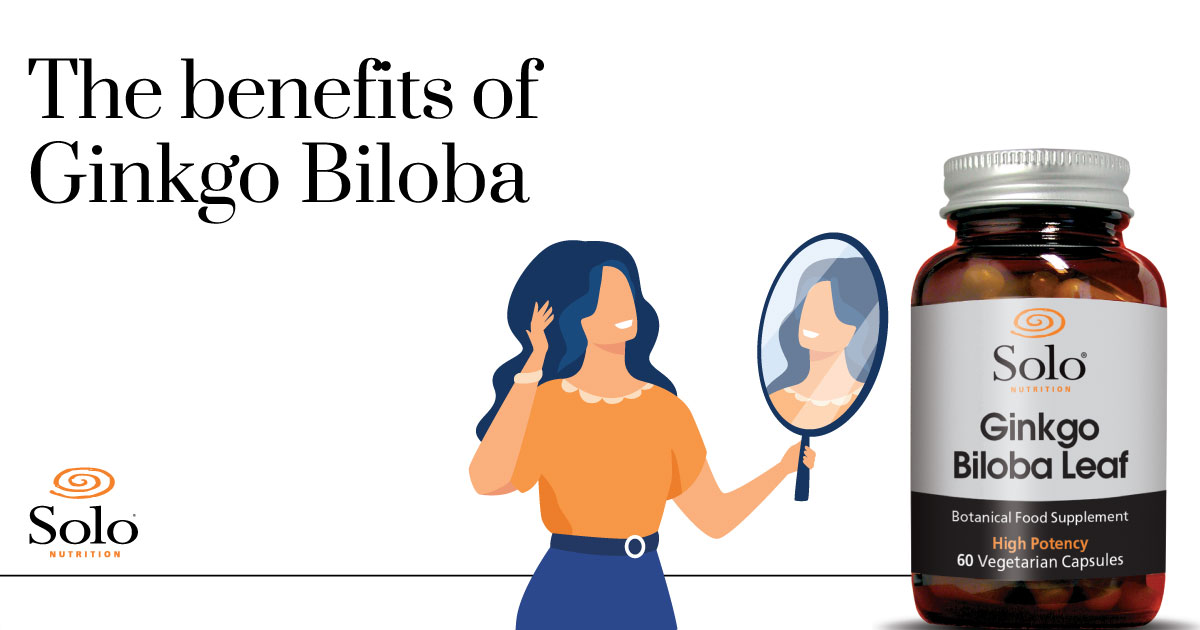
In this issue, Solo Nutrition looks at… The benefits of Ginkgo biloba (High Strength)
The Ancient Origins of Ginkgo Biloba
Did you know that ginkgo biloba is the world’s oldest living species of tree and can be traced back more than 200 million years? The tree, which grows in China, Korea, southern France, and southern and eastern parts of the US, can live up to 1,000 years. While the edible seeds of the ginkgo fruit are eaten as a food in the orient, it’s the leaves that are used for medicinal purposes.
Key Health Benefits of Ginkgo Biloba
Probably the most well-known benefits of ginkgo biloba are in the treatment of age-related cognitive decline and Alzheimer’s disease [1]. However, because of its effect on blood flow and circulation, it’s recommended as a remedy for many other conditions including macular degeneration, diabetic retinopathy, glaucoma, tinnitus, vertigo, erectile dysfunction and peripheral arterial insufficiency [2][3].
How Does Ginkgo Biloba Work?
Ginkgo contains two major groups of active components – ginkgo flavone glycosides which make up 24 per cent of ginkgo extract, and terpene lactones which make up six per cent of ginkgo extract [2]. The herb has several modes of action in the body. Firstly, it is a powerful antioxidant, helping to scavenge free radicals in the brain, the retina of the eye and the cardiovascular system [1]. Secondly, it inhibits excess blood clotting, thereby preventing thickening of the blood and supporting blood flow to different organs. Finally, ginkgo increases the body’s production of ATP, which is the main source of cellular energy [1]. This activity has been shown to boost the brain’s metabolism of glucose, vital for normal brain function.
What Does the Research Say?
Numerous studies confirm that ginkgo helps improve memory loss [1]. This is thought to be achieved by its ability to supply adequate glucose to the brain, in addition to increasing blood flow. The herb also appears to improve the brain’s use of acetylcholine, a chemical that allows the nerve cells responsible for memory to communicate properly.
Eye conditions, such as those mentioned above, seem to improve with ginkgo supplementation – again due to its affinity with the circulatory system. A 2021 review confirmed that Ginkgo biloba extracts “might be a good option to improve certain neurodegenerative retinal diseases” including age-related macular degeneration, diabetic retinopathy, and glaucoma [3]. Having antioxidant properties, it’s also able to slow down cataract formation, which is associated with free radical production.
In relation to cardiovascular disease, ginkgo is a valuable remedy. In one study, 79 patients with intermittent claudication due to peripheral atherosclerosis received ginkgo or a placebo for six months. Pain reduction was four times greater in the ginkgo group than in the placebo group [2]. Further analysis showed a significant increase in blood flow on the affected side in patients taking ginkgo, compared to a slight decrease in blood flow in the placebo group. A 2026 study on thromboangiitis obliterans (a type of peripheral vascular disease) found that Ginkgo biloba extract combined with urokinase significantly improved pain scores, haemodynamics, and long-term prognosis [4].
Although tinnitus sufferers often report an improvement in symptoms with ginkgo intake, some studies confirm these findings while others contradict them. The largest trial of Ginkgo biloba for tinnitus, published in the British Medical Journal (2001) and involving 1,121 participants, found that ginkgo was no better than placebo for treating tinnitus alone [5]. However, according to Dr Ewart Davies of The British Tinnitus Association, who co-authored the study:
“It must be remembered that ginkgo is an extremely safe material and that most people who take it report a better feeling of well-being. This of course allows patients to deal with their tinnitus rather better. So, if patients can afford it and they feel that their tinnitus eases, then they should continue to take it.”
The researchers also noted that Ginkgo biloba “may be effective in treating tinnitus in patients who also have other symptoms of cerebral insufficiency” (poor blood flow to the brain) [5].
Other promising areas of ginkgo research include depression, impotence, deafness, PMS and asthma.
Ginkgo Biloba Leaf is part of Solo Nutrition’s botanical and herbal range of remedies. Our Ginkgo Biloba is a high potency 6000mg standardised extract, enhanced with vitamin E and Rutin to complement its efficacy.
References
- “Improvement of age-related neurocognitive disorders by Ginkgo biloba extract: neuroprotection in focus” – Eckert A et al., International Journal of Psychiatry in Clinical Practice, 2026. PubMed PMID: 41574926.
- “Ginkgo Biloba Extract” – ScienceDirect, various chapters including “Peripheral Vascular Diseases” and “Ginkgo (Ginkgo biloba L.)”.
- “Neuroprotective potential of Ginkgo biloba in retinal diseases” – Martínez-Solís I et al., Planta Medica, 2021. Review on age-related macular degeneration, diabetic retinopathy, and glaucoma.
- “Clinical value of targeted arterial infusion of ginkgo biloba extract combined with urokinase in thromboangiitis obliterans” – Liu Z et al., American Journal of Translational Research, 2026. PMID: 41676274.
- “Popular herb no cure for ringing ears” – ABC Science, 17 January 2001. Reporting on the Drew & Davies BMJ tinnitus trial (1,121 participants).