Table of Contents
We have around 40 trillion bacteria in and on our bodies (Sender et al., 2016)
. Most of these can be found in our intestines, and they are very beneficial for our health. Science is starting to show just how important the bacteria in our intestines are. All these bacteria are now being referred to as our gut microbiome or microbiota (Turnbaugh et al., 2007)
.
Good Bacteria vs Bad Bacteria: The Battle Within
The types and numbers of bacteria are constantly changing. There are good bacteria like Lactobacillus and Bifidobacterium, and bad bacteria like Enterobacteriaceae, that are constantly competing against each other for food and space (Kamada et al., 2013)
.
How Lifestyle Affects Your Gut Microbiome
Our lifestyles have a big effect on the number and types of bacteria. Our diet is very important—the wider the range of foods we eat, especially fruits, vegetables, and high-fibre foods, the more it increases the numbers and types of bacteria (David et al., 2014)
. Unfortunately, in the UK we eat a lot of processed, sugar-rich foods, and these tend to reduce the numbers and types of bacteria found (Martinez et al., 2015)
.
Stress also plays a big part in the health of our digestive systems. Stress has a negative effect on our microbiome (Foster et al., 2019)
.
Why Take a Probiotic Supplement?
Many people now find taking a daily supplement of friendly bacteria very helpful (Hill et al., 2014)
. A daily supplement helps top up the numbers of good bacteria; however, most supplements available do not contain a wide range of bacteria. We have worked very closely with nutritional biochemists to develop a unique high-strength (50 billion) supplement containing 22 different strains of friendly bacteria plus prebiotics, inulin, and psyllium husks. Each daily capsule contains 50 billion “good bacteria,” which is up to five times more than a typical micro-biotic drink.
Surviving the Journey: Getting Bacteria to Your Intestine
To get to the intestine, bacteria have to survive stomach acid and bile in order to arrive in the intestine (Ouwehand et al., 2016)
. That is why we have used specially developed delayed-release capsules which dissolve lower down the digestive system to make sure they arrive in the intestine in good condition.
Feeding Your Good Bacteria: The Role of Prebiotics
We do not stop there. We have also added two different sources of fibre—inulin and psyllium husk—which provide good bacteria with their favourite food to help them grow and compete with bad bacteria (Gibson et al., 2007)
.
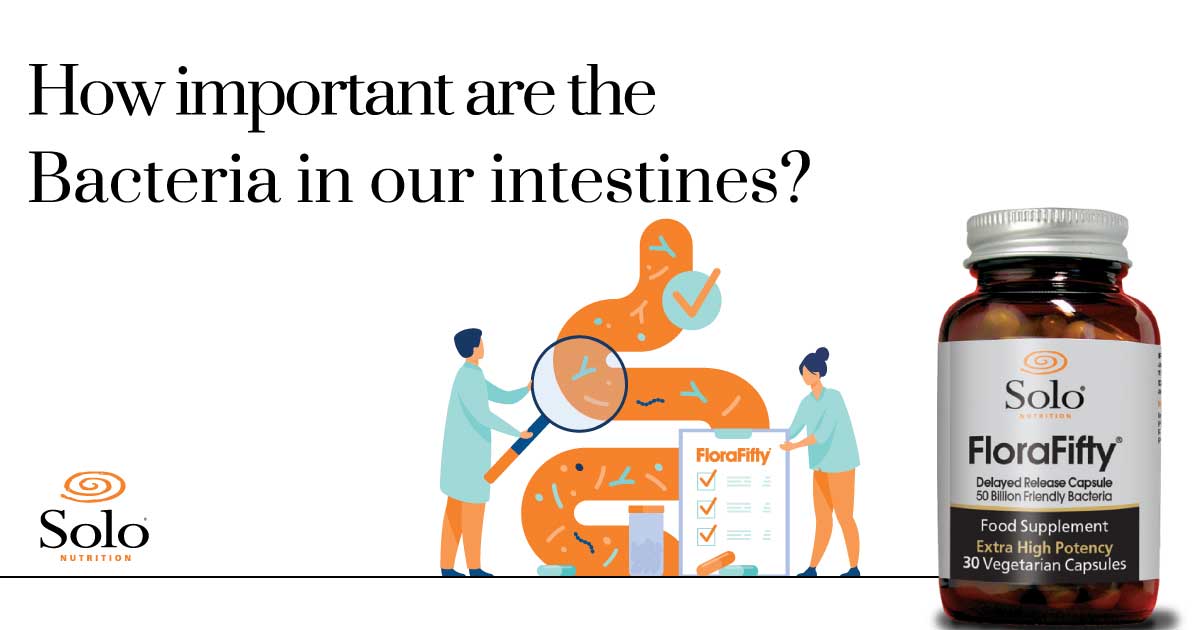
Solo Nutrition’s extra high-potency FloraFifty contains a total of 50 billion live ‘friendly’ bacteria, consisting of 22 different strains, plus the prebiotic fibres inulin and psyllium husks.
-

FloraFifty™ Flora Probiotic Supplement
£37.99 Select options This product has multiple variants. The options may be chosen on the product page

References
- Sender, R., Fuchs, S., & Milo, R. (2016). Revised estimates for the number of human and bacteria cells in the body. Cell, 164(3), 337-340. doi:10.1016/j.cell.2016.01.013
- Turnbaugh, P.J., Ley, R.E., Hamady, M., et al. (2007). The human microbiome project. Nature, 449(7164), 804-810. doi:10.1038/nature06244
- Kamada, N., Chen, G.Y., Inohara, N., & Núñez, G. (2013). Control of pathogens and pathobionts by the gut microbiota. Cell Host & Microbe, 13(6), 645-656. doi:10.1016/j.chom.2013.06.007
- David, L.A., Maurice, C.F., Carmody, R.N., et al. (2014). Diet rapidly and reproducibly alters the human gut microbiome. Nature, 505(7484), 559-563. doi:10.1038/nature12820
- Martinez, K.B., Leone, V., & Chang, E.B. (2015). Western diets, gut dysbiosis, and metabolic diseases: Are they linked?. Cell Metabolism, 22(5), 780-791. doi:10.1016/j.cmet.2015.10.001
- Foster, J.A., Rinaman, L., & Cryan, J.F. (2019). Stress and the gut-brain axis. Current Opinion in Behavioral Sciences, 28, 48-54. doi:10.1016/j.cobeha.2019.01.011
- Hill, C., Guarner, F., Reid, G., et al. (2014). Expert consensus document: The International Scientific Association for Probiotics and Prebiotics consensus statement on the scope and appropriate use of the term probiotic. Nature Reviews Gastroenterology & Hepatology, 11(8), 506-514. doi:10.1038/nrgastro.2014.66
- Ouwehand, A.C., Bergsma, N., & Snel, J. (2016). Probiotic survival in the gastrointestinal tract. Microbial Cell Factories, 15(1), 156. doi:10.1186/s12934-016-0543-8
- Gibson, G.R., Probert, H.M., Van Loo, J., et al. (2007). Dietary modulation of the human colonic microbiota: updating the concept of prebiotics. Journal of Nutrition, 137(11), 2493S-2502S. doi:10.1093/jn/137.11.2493s

Nigel came into the natural products industry in 1980 working for a small vitamin/herbal company, Power Health, specialising in the food supplement side of the natural products industry. After gaining a number of years’ experience and expertise, Nigel joined Solgar Vitamins as one of their first recruits in 1989. He gained a vast array of knowledge in manufacturing and the production side of the business with Solgar. Nigel was commissioned to start two companies; Vega Nutritionals and Kudos Vitamins. This experience was invaluable when Nigel started Solo Nutrition – quality, purity, never compromised, never equalled.