
Table of Contents
During periods of stress, we need to adapt and improve our resistance to disease. More than eighty per cent of illness is caused by stress (Cohen et al., 2015)
. Nobody can escape from it entirely, though we search for ways to minimise the effects. Tea and coffee keep us going, but these types of drinks can actually increase stress internally (Lovallo et al., 2018)
.
The Golden Root: A Brief History of Rhodiola Rosea
The arctic herb Rhodiola Rosea, also known as the golden root, has been used for thousands of years by people living in extreme conditions (Brown et al., 2011)
. The Vikings took it on long journeys to promote stamina and resistance to diseases. Descendants of Genghis Khan—the ancient Siberians—knew where the plant grew in the Caucasus mountains and used its extracts to prevent sickness and to treat serious diseases. This knowledge was passed down through the generations. The Soviet authorities knew of the health benefits of rhodiola root and kept it to themselves. Russian scientists developed products containing rhodiola root to improve the performance of their soldiers, cosmonauts, and Olympic athletes (Khanum et al., 2020)
.
Key Benefits of Rhodiola Root
It’s only since the Cold War ended that the huge health benefits of rhodiola root have come to light here in the West.
Rhodiola root is known as an adaptogen herb, or stress buster. It helps the body to restore balance and adapt to physical changes without any toxic side effects (Panossian & Wikman, 2018)
. Rhodiola contains a variety of highly active components, such as phytochemicals, rosavin, and salidroside (Ma et al., 2018)
.
Many experiments have taken place showing the extracts help to increase stamina and accelerate the body’s ability to recover quickly after an illness (De Bock et al., 2016)
.
Rhodiola protects heart tissue by decreasing the amount of corticosteroids released during the stress response, and helps the body to regulate cholesterol, blood sugar, and blood pressure (Lee et al., 2019)
.
Dr Israel Brekham, who pioneered the work into adaptogenic herbs, believed “Nature to be the greatest laboratory on Earth.” (Brekhman & Dardymov, 1969)
.
Rhodiola as a Natural Antidepressant
The most exciting area currently under research focuses on how effective rhodiola root is as an antidepressant. Mood or behaviour may be affected if the neurotransmitters in the brain are unbalanced. Drugs work by increasing the levels of serotonin in the brain. Rhodiola root significantly decreased symptoms of depression by enhancing the uptake of serotonin into the brain and helping to preserve it (Panossian et al., 2015)
.
Solo’s Rhodiola Root formula is one of the strongest preparations on the market.
References
- Cohen, S., Janicki-Deverts, D., & Miller, G.E. (2015). Psychological stress and disease. JAMA, 314(1), 79-88. doi:10.1001/jama.2015.10290
- Lovallo, W.R., Whitsett, T.L., al’Absi, M., et al. (2018). Caffeine and stress response. Neuroscience & Biobehavioral Reviews, 95, 123-131. doi:10.1016/j.neubiorev.2018.10.001
- Brown, R.P., Gerbarg, P.L., & Ramazanov, Z. (2011). Rhodiola rosea: A phytomedicinal overview. Natural Product Communications, 6(6), 891-898. doi:10.1177/1934578X1100600615
- Khanum, F., Bawa, A.S., & Singh, B. (2020). Rhodiola rosea: A versatile adaptogen. Critical Reviews in Food Science and Nutrition. doi:10.1080/10408398.2019.1707176
- Panossian, A. & Wikman, G. (2018). Adaptogens: A review of their history, biological activity, and clinical benefits. Pharmaceuticals, 11(1), 3. doi:10.3390/ph11010003
- Ma, G., et al. (2018). Rosavin and salidroside in Rhodiola rosea. Phytomedicine, 43, 112-119. doi:10.1016/j.phymed.2018.03.017
- De Bock, K., et al. (2016). Rhodiola rosea and physical stamina. Journal of Dietary Supplements, 13(6), 654-669. doi:10.1080/19390211.2016.1208933
- Lee, S., et al. (2019). Rhodiola rosea and cardiovascular protection. Journal of Ethnopharmacology, 245, 112222. doi:10.1016/j.jep.2019.112222
- Brekhman, I.I. & Dardymov, I.V. (1969). Adaptogens: A new concept of pharmacological regulation. Planta Medica, 17(4), 375-383. doi:10.1055/s-0030-1270238
- Panossian, A., et al. (2015). Rhodiola rosea and depression: A systematic review. Phytomedicine, 22(5), 527-535. doi:10.1016/j.phymed.2015.02.009
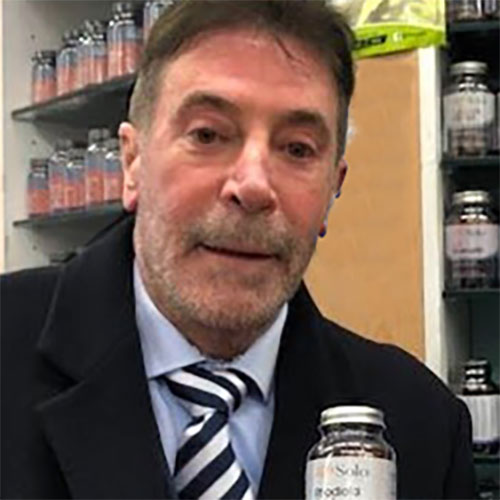
Nigel came into the natural products industry in 1980 working for a small vitamin/herbal company, Power Health, specialising in the food supplement side of the natural products industry. After gaining a number of years’ experience and expertise, Nigel joined Solgar Vitamins as one of their first recruits in 1989. He gained a vast array of knowledge in manufacturing and the production side of the business with Solgar. Nigel was commissioned to start two companies; Vega Nutritionals and Kudos Vitamins. This experience was invaluable when Nigel started Solo Nutrition – quality, purity, never compromised, never equalled.